
Welcome to Valonia
A few weeks ago, I flew to Utah for a friend's wedding. I lived there during college, and I grew up in Alberta, along the Rockies, so mountains were the ordinary backdrop for most of my life. Then I moved to Texas. I didn't understand how much I missed them until I walked out of a hotel in Provo and there they were—the same canyon roads I used to drive on the way to picnics I hadn't thought about in years. On my way to the rehearsal dinner, I drove through Provo Canyon, mountains close on both sides, a lake and a river down the middle, and I remembered why I used to stop there just to stand by the water.
I bring this up because it explains the shape of my empire.
When I started picturing Valonia, I knew I wanted a Roman-inspired world. But Rome itself sits in low hills—the city isn't ringed by anything grand, and I wanted grand. So I moved my eye east, toward the territory the old Persian Empire once held, where mountain ranges wall in the north and the east and the land falls away into sand and cliff to the south. Valonia isn't a copy of that map. It borrowed its bones and its sense of scale.
Today I'm revealing two of the maps I had made—the empire, and the capital city at its center—and introducing you to the world.
The empire
Map created by Daniel Maps
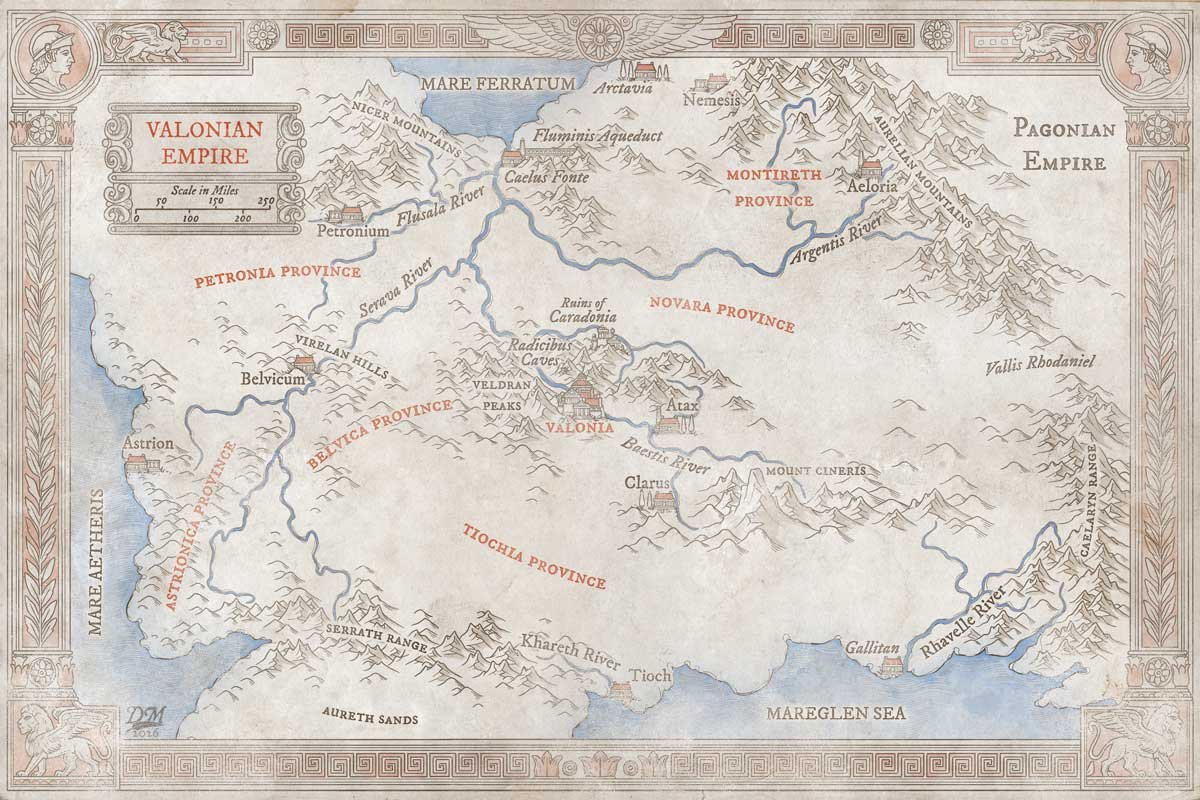
Valonia is an empire and also a city, and they share a name for an old reason. The empire is centuries older than its capital—both take their name from the Valon, a trading family whose name long outlived their fortune. The empire spreads across the continent of Ostraia, held together by roads, rivers, trade, military service, and an almost religious belief in public duty.
For its early history, the empire was ruled from Caradonia, the first capital. The city of Valonia came later—a river town on the Baetis, sheltered under a wall of cliffs—and it only became the seat of power after Caradonia fell. What's left of the old capital lies near the center of the map, marked as ruins. An empire that has already outlived one capital tends to build the next one to look permanent.
Valonia was never one people. Astrion sits on the western coast and lives by ships, salt, and public argument—a merchant city that debates everything out loud. Belvicum works in cloth, dye, and mosaic. Aeloria is cut into the mountains, a city of stonemasons and fortifications and men who study tactics for sport. Tioch is barely a city at all—a loose confederation of ranching clans who answer to their land and their blood before they answer to any emperor. Atax grows the grain. Clarus grows the wine. Petronium mines gems up in the rock and keeps its old oaths carved into the mountain face.
To the east, across the border, sits the Pagonian Empire. Everywhere else, the land does the guarding—the Nicer and Aurelian ranges in the north, the Serrath and Caelaryn ranges to the south and east, the Aureth Sands, and three seas.
The city of Valonia
Map created by Daniel Maps
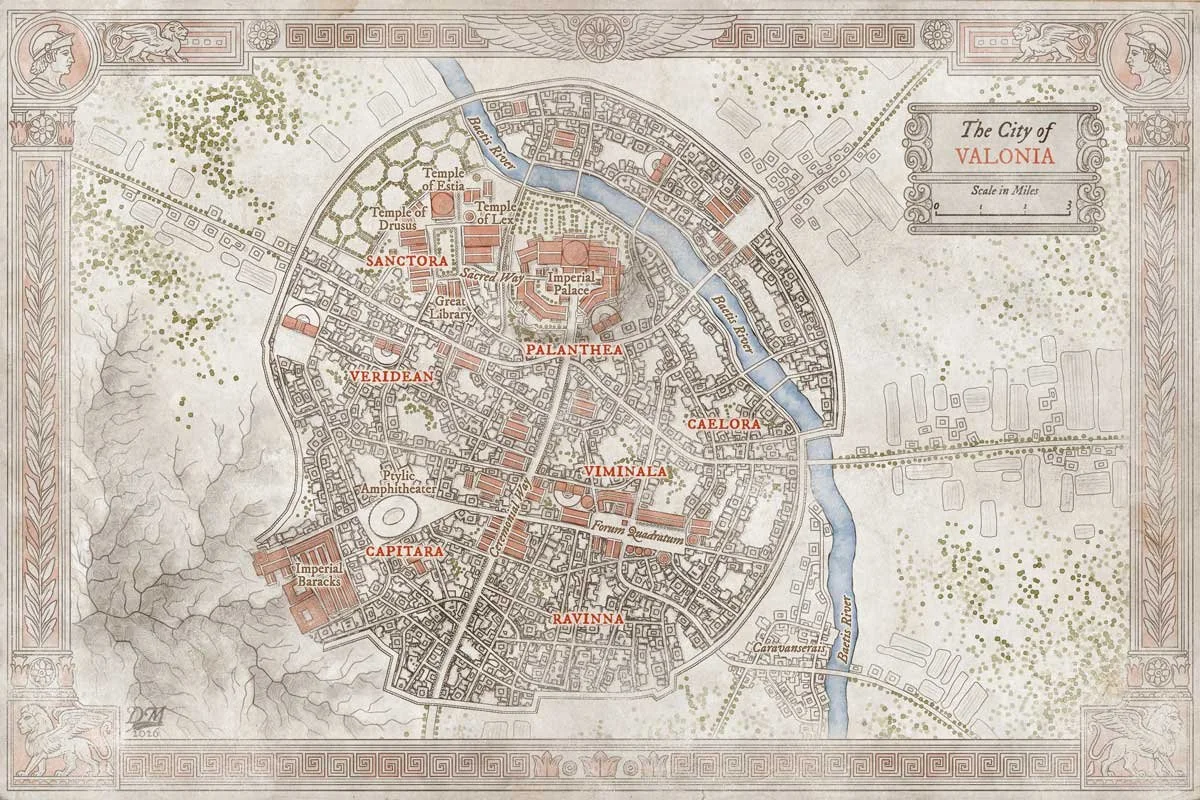
The capital is circular, wrapped around a bend of the Baetis River, and you can read the whole social order in how it's divided.
Palanthea holds the Imperial Palace. Sanctora is the sacred and scholarly quarter, where the Great Library stands and three temples—Estia, Lex, and Drusus—line the Sacred Way. Caelora is old money, the district of noble houses and ancestral estates. Veridian is where the artists are. Viminala is where the money moves, around the Forum Quadratum. Ravinna is the working district. Capitara is the army, its Imperial Barracks close enough to the palace to read as either comfort or warning, depending on the week.
What I keep thinking about is the distance between those districts. Sacred avenue to military barracks. Noble estate to working street. A short walk on the map, and a long way in every other sense.
What a map shows
This reveal is about the places, the customs, the institutions—the parts of Valonia you could walk through. So here's one civic thing. Valonia runs on public honor, and it means it literally. Non-magical boys come up through the Proelium Civica—games that test endurance, rhetoric, strategy, and public virtue—before they enter a rite called Gloritas. A family stakes its name on how a boy performs. There are ceremonies to present a son to his lineage, to adopt a promising boy into a house that will have him, and—the one that stays with me—to cut a dishonored child out of the family line entirely. Honor here is never only symbolic. It becomes a career, a marriage, or a weight a man carries the rest of his life.
That's what I hoped these maps would carry, past the rivers and the ranges. A map like this ends up being a record of what an empire values—and where it's beginning to crack.
Coming up
The Emperor’s Shadow comes out October 12. The next few posts will begin to reveal more about the novel and the world. Sigils, emblems, my character art, and of course my book cover.