
Six women and a Sacred Fire
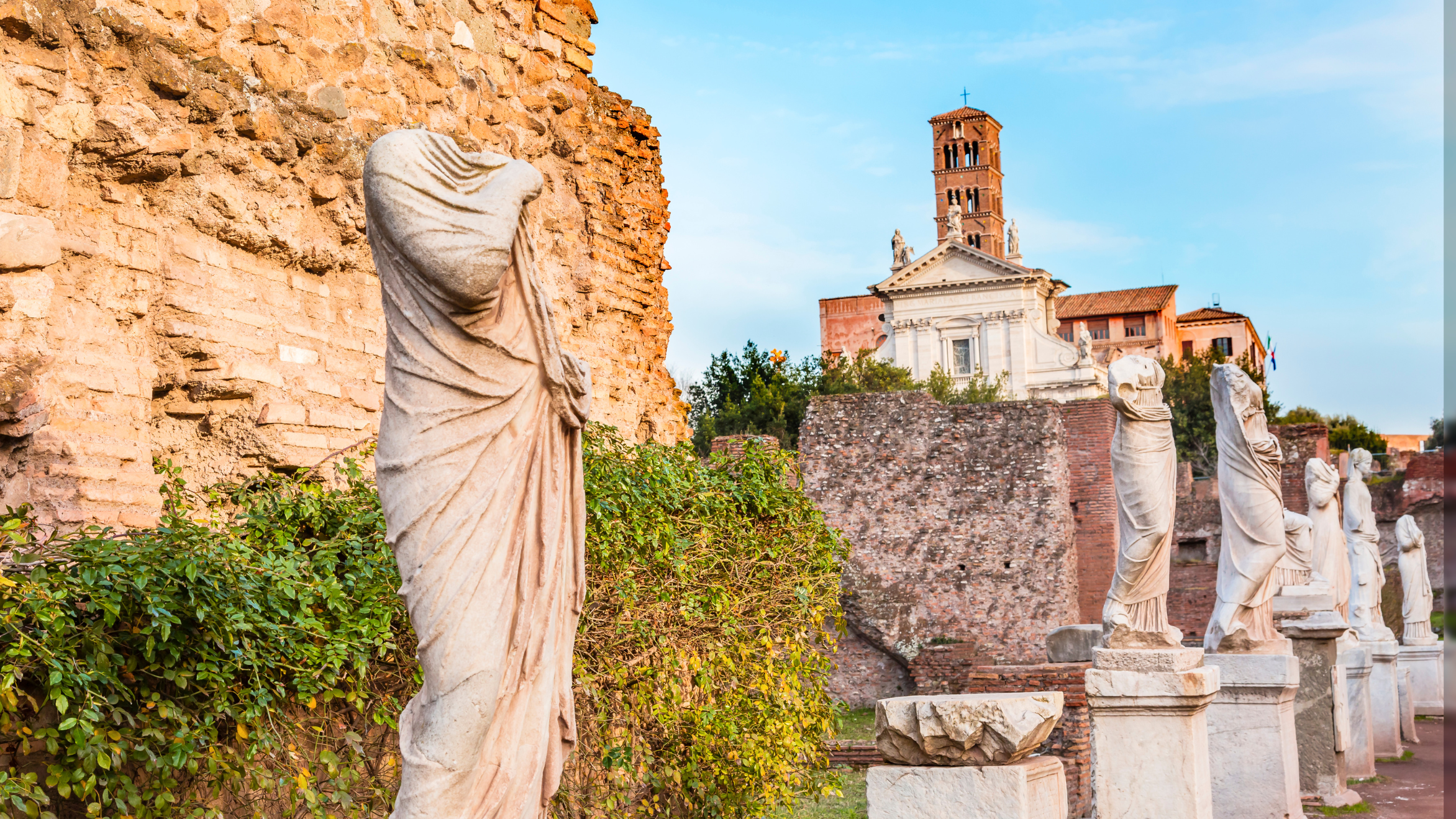
Their most important duty was keeping and tending the sacred fire in the temple of Vesta. The goal was to never let it go out — it was considered an omen foretelling the destruction of the city if it ever did. Every March 1st, the fire was relit in a ceremony by rubbing two sticks together. Six women were responsible for making sure that was never necessary.
These were the Vestal Virgins. They were also, in a society that gave women almost no legal standing, the most politically consequential women in the empire.
Vesta is the Roman version of the Greek goddess Hestia. Hestia was the eldest daughter of Kronos and Rhea — the first to be swallowed and subsequently disgorged by her father, possessor of a distinctly unlucky birth order. According to legend, the eldest sister of Zeus never married, presided over all sacrifices, and was credited with establishing the idea of building houses as home. When the Romans extended their reach and adopted the Greek gods, they gave them Roman names and converted the same ideology into their own practice. Hestia became Vesta. Her sanctuary became a place of refuge for anyone who needed it.
The women who served her were the Vestals — six priests, though "priest" is a complicated word for what they were. Women couldn't be priests in Rome. When a girl was chosen as a Vestal, she in effect surrendered her gender. She would never marry. She would never bear children. She would remain a virgin for the full thirty years of her service, after which she was technically free to leave — though most didn't.
Membership was pretty exclusive. Selection happened between the ages of six and ten, from patrician families, and it was considered a great honor to have one of your daughters chosen. A girl's father relinquished the paterfamilias — the legal control he held over her, the ownership that would otherwise pass to a husband — and that authority transferred instead to the state. The state funded them and housed them in an official residence. The state, if necessary, also killed them.
The punishment for breaking the chastity vow was death. There are some pretty grisly accounts of Vestal Virgins having been killed for it. The method of execution was to be buried alive, as it was prohibited to strike a priestess of Vesta. The woman was dressed in funeral clothes — normally they were dressed in white — and carried in a formal procession with her friends and relatives lamenting around her, then placed in an underground room. We know there's evidence of it being done under the emperor Domitian in 83 CE. That particular year, three Vestals were executed for immorality, and the chief Vestal was buried alive as well.
Even with that hanging over their heads, membership was a way for women to take an active role in Roman public life outside of the traditional role of being just a wife or a mother.
Roman women had almost no legal standing otherwise. Starting around 450 BCE, when the Law of the Twelve Tables was written, women's position before the law became officially recorded: women, even though they are of full age, because of their levity of mind, shall be under guardianship. They were not supposed to control their own property or bring their own legal cases. At the death of the father, custody passed to the nearest male relative.
The Vestals were exempt from all of it. They could own property, make wills, and give testimony in court without a guardian. They were received with public honors — the best seats at gladiatorial games, and at the theater. Their word carried weight. On the rare occasion that a condemned man crossed their path while being led to execution, their mere presence was grounds for a pardon.
There is also this, which I kept returning to: instead of dedicating their fertility to a man for the purpose of his generational continuity, the Vestals were understood to be dedicating it to the ongoing vitality of Rome itself. Their fecundity belonged to the empire. As a result, they held a kind of civic power that no married Roman woman could access — economically independent, legally autonomous, and politically consequential in ways their married sisters simply weren't.
I've never married. I've never had children — that door closed at twenty-five, by way of a cancer diagnosis, though I didn't understand yet what I was losing. I was reading about the Vestals years later, in the middle of building an imaginary empire, when it occurred to me that I could see it. If I were Roman, if those were my options, I might have signed on for that. The opportunity to be educated, to wield political power to some extent, to be a symbol for the empire — knowing I was never going to marry and have children anyway, I could have done it. The thirty years. The white dress. Yet, a woman was selected when she was just a child and could not yet know what she would have wanted. The choice was made for her — but the fact that most Vestal Virgins did not abandon their role even after their thirty years were up suggests they must have found some satisfaction in it.
Because there was a lot of superstition attached to the Vestal Virgins, they were also tied to the success of the Roman Empire and could be used as scapegoats when the empire's fortunes started to go downhill. That I would not have loved at all.
The story I ended up writing started with that same paradox — a woman holding real power inside an institution that controls everything about her life. The name changed: Vesta becomes Estia, just different enough to give me room to build. The sacred fire stayed, because that piece of mythology didn't need improving. The omen holds. If the flame dies, the empire suffers — and in the world I was building, I wanted that to be true in the politics of the story and in everything running underneath the politics.
The first question I kept asking myself was what happens when one of these women has magic. What does that gift do, and what does the empire want to do with it? In the world I built, the priestesses of Estia are healers — their magic costs them something real each time they use it, which means the empire's interest in them goes considerably beyond the ceremonial. The Sanctora, where they live and work and train, is a much larger institution than six. It has to be, given what they're asked to carry.
But the thing I kept circling back to, deep in the research, had less to do with the magic and more to do with what I'd found in the actual historical record. The Vestals weren't passive symbols. They were politically active, legally autonomous, occasionally inconvenient, and fully aware of the weight their presence carried in a room. They outlasted emperors. I wanted that quality in my priestesses — that sense of an institution in constant, low-grade negotiation with the women inside it — and in Book One, the head of my temple is a woman named Lydia who is, very deliberately, not requiring her priestesses to fulfill the obligations the empire believes it's owed. She has her reasons. The empire has its objections. I found it was a more interesting argument than I'd expected when I started.
Not all of the Vestals' historical constraints apply at the start of my story. What the priestesses of Estia are and aren't permitted in Book One — the vows, the laws, the question of what they owe and to whom — sits at a deliberate distance from the record. By Books 2 and 3, the rules and freedoms that the priestesses of Estia have begin to more closely match what the reality of a Vestal Virgin was. In Book One, that is not yet the case. Things will change, and I won't tell you why. I spent a long time working out why, because it mattered to me that it happen for reasons rooted in the world I was reading about, not just because the plot needed it to.
Whether I pulled that off is something readers will eventually tell me.
The Emperor's Shadow, Book One of Empire of the Shattered Heavens, publishes October 12.
Sources and further reading
Aulus Gellius. The Attic Nights of Aulus Gellius. Vol. I. Translated by John C. Rolfe. Cambridge and London: Loeb Classical Library, 1927.
Beard, Mary. SPQR: A History of Ancient Rome. Liveright Publishing, 2015.
McGeough, Kevin M. "Vestal Virgins." World History: Ancient and Medieval Eras. ABC-CLIO, 2026. ancienthistory.abc-clio.com/Search/Display/1603348. Accessed 25 May 2026.
Salisbury, Joyce. "Roman Women." World History: Ancient and Medieval Eras. ABC-CLIO, 2026. ancienthistory.abc-clio.com/Search/Display/576080. Accessed 25 May 2026.